
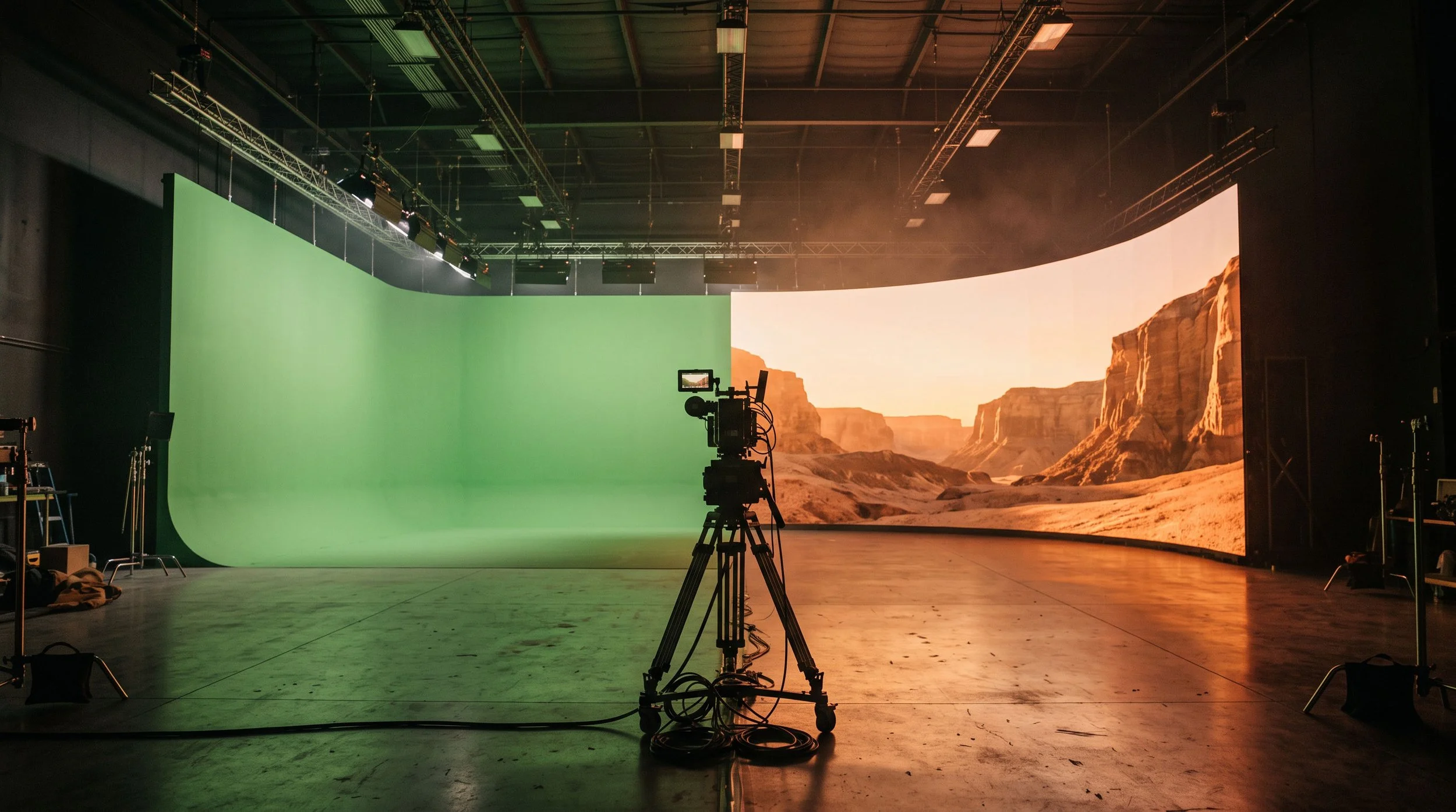
Green screen and LED volumes solve the same problem: the story happens somewhere you cannot, or should not, take a crew. They solve it at opposite ends of the schedule. With green screen, the background is decided after the shoot. On an LED volume, it is decided before. Most of the trade-offs follow from that.
What an LED volume gives you
The background is on the wall while you shoot, so the camera records a finished image.
Real light and reflections. The wall lights the subject with the colours of the scene. Cars, glass, bottles, jewellery and skin pick up reflections that would otherwise have to be added by hand.
Everyone sees the shot. Director, client and talent look at the monitor and see the frame, not a green rectangle. Decisions happen on set, with the people who approve them in the room.
Less to do afterwards. Shots that work in camera skip keying, rotoscoping and compositing. The edit starts with images that already look like the film.
Control over time and weather. Sunset holds for as long as the schedule needs it. Three locations in one day is a matter of loading the next environment.
What green screen still does better
Late decisions. If the background is not designed yet, or may change after the shoot, green screen keeps that door open.
Very wide frames. A wall has edges and a height. Shots that see far beyond it, or see the whole floor in every direction, need set extensions either way.
Heavy visual effects. If creatures, destruction or large simulations will be added in post regardless, much of the frame will be rebuilt anyway.
A cheaper shoot day. A green stage costs less per day than a volume with its crew. The bill arrives later, shot by shot, in post.
Where the money goes
Neither approach is cheaper in general. They move the cost. An LED shoot puts it up front: environments are built, tested and approved before the first shoot day, and the stage comes with operators. A green screen shoot puts it at the back: every shot is keyed and composited, and that cost grows with the shot count. A handful of shots favours green screen. A day of forty setups against the same few backgrounds tends to favour the wall.
You can mix them
The choice is rarely all or nothing. A volume can display green: a patch of green behind the subject, inside the camera's view, while the rest of the wall keeps showing the environment. The subject still gets the scene's light and reflections, and post still gets a clean key for the shots that need one. Many shoots run their close and medium shots in camera and reserve green for the two or three frames that need flexibility.
Five questions that settle it
Is the background designed and approved, or still open?
Is the subject reflective? Cars, liquids, glass and metal lean hard towards LED.
How many shots share the same background?
How wide is the widest frame, and does it see the floor?
How much time is there between the shoot and delivery?
If the answers are approved, reflective, many, medium and not much, book a volume. If they are open, matte, few, very wide and plenty, green screen will serve you well. Most projects land in between, which is a good reason to talk the shot list through before choosing a stage.
Planning a shoot and not sure which way to go? Write to wlab@wlab.tech with your boards and we will tell you how we would approach it.
Cover image: an illustration generated for this article, not a photograph of a WLAB shoot.
