
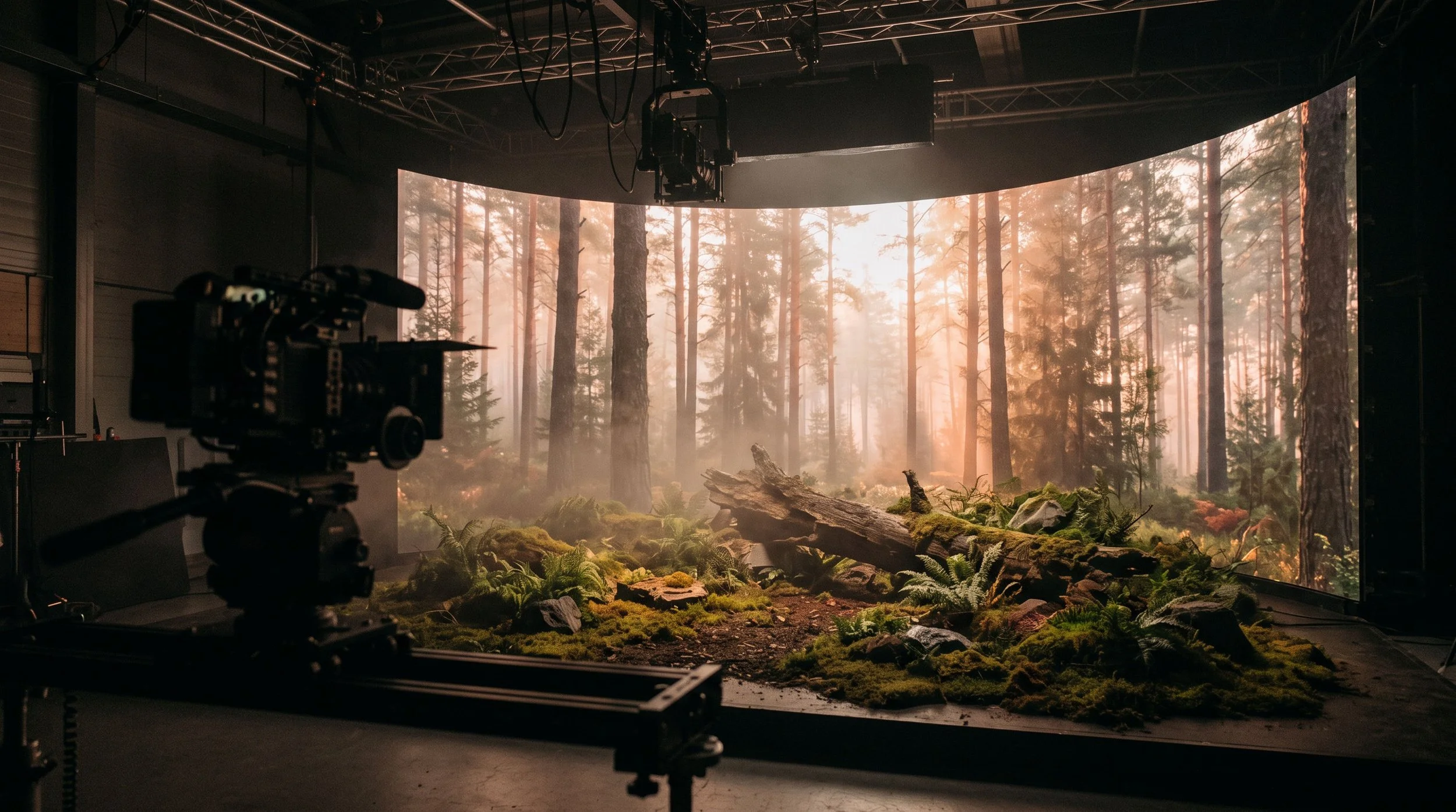
A 3D environment for an LED volume has a harder job than a still render. It has to draw itself many times a second across a very large screen, respond to a moving camera and sit behind real people under real light without giving itself away. These are the things we look at when we build one.
It runs in real time, without dropping frames
The wall is driven by a game engine, in our case Unreal Engine, that renders the scene live. If the frame rate dips, the background stutters and the camera records it. Geometry, textures and lighting are budgeted from the start so the scene holds a steady frame rate at the wall's full resolution. A beautiful scene that cannot do that is not usable.
It is built to real scale
Camera tracking moves the virtual camera exactly as far as the physical one. If a doorway in the scene is three metres tall when it should be two, the parallax will be wrong and the eye will notice, even if nobody can say why. Environments are modelled in real-world units and checked against a human figure.
Its light agrees with the stage
The wall lights the subject, and stage fixtures finish the job. Both have to tell the same story about where the sun is and what colour the sky is. We build environments with a clear, motivated light direction and share it with the gaffer, so the highlight on the talent's cheek and the shadows in the background agree.
The join with the physical set is hidden
The most fragile part of the frame is the line where the real floor meets the wall. Matching materials on both sides helps: the same sand, the same concrete, the same moss. So does set dressing placed to break up the edge, and a camera height that keeps the join out of the clearest part of the shot.
Detail is spent where the lens can see it
The wall usually sits behind the subject and slightly out of focus. Far-background detail that would take weeks to model will be a soft blur in the final frame. The mid-ground, where depth cues live, deserves the effort. Knowing the lens and the distance from subject to wall tells the 3D team where to spend their time.
It survives dark scenes
Night exteriors and dim interiors are the hardest case. Any stage light that spills onto the wall lifts its blacks and flattens the image. Dark environments need lighting plans that keep fixtures off the screen, and content with enough contrast to hold up when the blacks are not perfectly black.
Sometimes a plate is enough
Not every background needs a full 3D world. When the camera is locked off or moves very little, a photographed or filmed plate can look better and cost less. Driving footage for car interiors is the classic example. A full 3D build earns its place when the camera travels and the background has to shift with it.
Have a location in mind that you cannot shoot in? Tell us about it at wlab@wlab.tech.
Cover image: an illustration generated for this article, not a photograph of a WLAB shoot.
